
What if we went to Titan?
 Par
Leia Desautel
Par
Leia Desautel
Dans Solar system
 Titan above Saturn from NASA’s Cassini spacecraft. Credit: NASA/JPL-Caltech/SSI
In the 1970s, when the Apollo missions to the Moon came to an end, two probes were sent to explore our solar system: Voyager 1 and 2. In 1980, during its quest, Voyager 1 passed within tens of thousands of kilometers of Titan and, despite the opacity of its atmosphere, sent back data revealing the presence of methane, one of the building blocks of organic chemistry, the chemistry of life. These findings and the great interest they generated led to the Cassini-Huygens mission project.
This mission is a collaboration between NASA, the European Space Agency (ESA), and the Italian Space Agency (ASI). Cassini is an orbiter carrying the Huygens probe, which is planned to be released onto Titan to collect data in situ using its six instruments to photograph and record physical and chemical characteristics. It is the first probe in the world to land on an unknown surface.

On October 15, 1997, the Centaur 4 rocket carrying Cassini took off. During the first two years, the spacecraft approached Venus, which is closer to the Sun than Earth, and used its gravitational pull to gain speed. Then, after a seven-year journey, Cassini finally arrived near Saturn. It passed through its rings and turned on its engines for the first time in several years to slow down and enter the planet's orbit. On December 24, 2004, Cassini released the Huygens probe to continue its journey to Titan. Finally, after a three-week approach, on January 14, 2005, Huygens approached the surface, protected by a solid thermal shield. The descent lasted two hours, during which several consecutive parachutes deployed, allowing the probe to finally land gently on the surface of the unknown world.

Cassini-Huygens around Saturn - Artist view
During descent and after landing, for another hour before the batteries finally ran out, Huygens transmitted the data it had collected to Cassini, which in turn transmitted it to Earth by radio. The probe made it possible to determine the surface of Titan and the composition of its soil and atmosphere.
Huygens landing at 30 km - Artist view
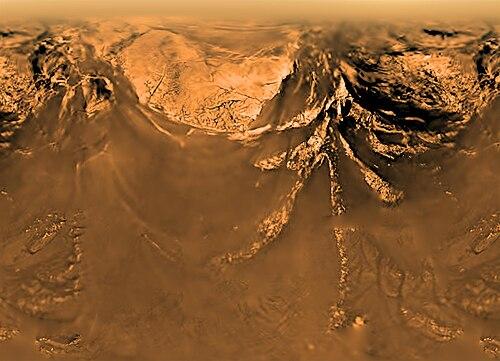
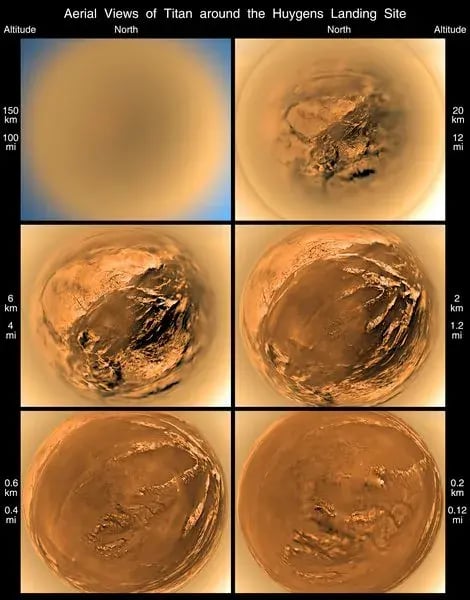
ESA/NASA/JPL/University of Arizona
For another 12 years after Huygens landed, Cassini continued to fly over Titan, up to 100 times, to map it, strip by strip. In 2007, the spacecraft observed lakes and rivers at Titan's north pole for the first time, comparable in size to those on Earth. Twelve years later, when the mission ended, in order to preserve the space environment, Cassini embarked on a final trajectory that concluded the mission in 2017: it plunged straight into Saturn, burning up completely in the planet's atmosphere.
Most of Titan's lakes and methane reservoirs are located at the poles. Observations made at the North Pole are similar to those discovered at the South Pole, where methane lakes and rivers are also present, albeit fewer in number.
 NASA - JPL
However, the surface temperature of Titan is only 94K (-179°C). These expanses are therefore not made of water, but of liquid methane. Titan is home to a methane cycle, similar to the water cycle on Earth. 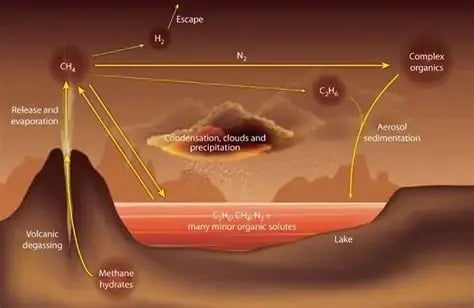
When temperatures rise, which is equivalent to a change of season (knowing that one season on Titan corresponds to seven years on Earth), the methane evaporates from the seas and condenses to form thick clouds reaching up to 45 km above the ground due to the lower gravity. Finally, the methane stored in the clouds falls to the surface in the form of rain, which can even be torrential, accompanied by heavy storms in the equatorial region during the equinoxes (when the sun is equitably distributed over the entire surface). The rain causes soil erosion and forms river deltas and valleys, as on Earth.
This reveals a truly dynamic cycle, which hides a complex climate model.
Furthermore, the source of methane on Titan remains a mystery. When exposed to sunlight, methane in the atmosphere breaks down into heavier elements which fall back to the surface. And there is no known chemical process that explains the formation of methane on Titan. Thus, this dynamic cycle could be only temporary if there are no sources.
Credit: Nature journal, Raulin (2008)
The existence of this dynamic, as well as the presence of methane, an organic molecule, inevitably raises the question of the possibility of life. Titan resembles Earth with its seasons, lakes, rivers, and cycle. We can fantasize about the possibility of human presence and about the development of extraterrestrial life.
However, to make this hypothesis realistic, when we talk about life as we know it, there would need to be liquid water. But at 94 K on the surface, water is solid. After a thorough analysis of Cassini's data, it is likely that Titan is composed of ice, mud, and small pockets of liquid water near the core.
Anyway, the Dragonfly mission made by NASA and scheduled for 2028 is on the horizon, and will allow us to learn even more about our little sister.
Dragonfly spaceship - Artist view
Ajouter un commentaire


